


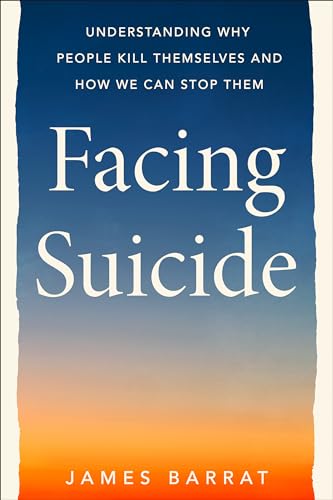
Facing suicide : understanding why people kill themselves and how we can stop them / James Barrat.
Publisher: New York : Avery, an imprint of Penguin Random House, 2024Description: 276 pages : illustrations ; 24 cmContent type:- text
- unmediated
- volume
- 9780593539156
- RC569 .B377 2024
 BOOKS
BOOKS
| Current library | Home library | Call number | Status | Barcode | |
|---|---|---|---|---|---|
| Alfaisal University On Shelf | Alfaisal University On Shelf | RC569 .B377 2024 (Browse shelf(Opens below)) | Available | AU00000000020633 |
Browsing Alfaisal University shelves, Shelving location: On Shelf Close shelf browser (Hides shelf browser)

|

|

|

|

|

|

|
||
| RC568.O45 S85 2021 Opioid reckoning : | RC568.O45 S87 2022 The rhetoric of the opioid crisis / | RC568.O45 W47 2019 Fentanyl, Inc. : | RC569 .B377 2024 Facing suicide : understanding why people kill themselves and how we can stop them / | RC569.B65 .T39 2016 Schooled on fat : | RC569 .C36 2017 Working in the dark : | RC569 .C478 2019 Clinical manual for assessment and treatment of suicidal patients / |
Includes bibliographical references and index.
"Suicide in America has become a public health crisis. Now this insightful book sheds much needed light on the many risk factors that combine to drive suicide forward so that we can try to identify and stop them. On average about 45,000 people in America die by suicide each year, a death toll higher than car accidents or homicides. For every person who dies there were are about 10 ten unsuccessful attempts. And every day some 15 million Americans endure suicidal ideatio n: persistent, agonizing thoughts about taking their lives. Profiling suicide survivors, their families, and experts in the field, Barrat begins to assemble a fuller portrait of suicide, examing such risk factors as genetics, means, mental health, and history. He specifically looks at the longterm affects of racial trauma, bullying, financial stress, and even reveals that the suicidal brain has a characteristic signature. Perhaps most important, Barrat finds that 100% of the people he interviews who attempted suicide are happy they got help and are alive today. Their message is one of hope and possibility. We may never be able to stop all suicide attempts, but with better understanding, we can stop many more"--