


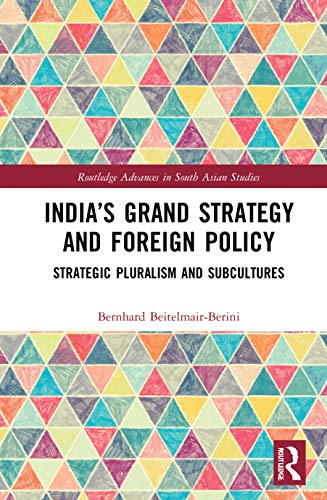
India's grand strategy and foreign policy : strategic pluralism and subcultures / Bernhard Beitelmair-Berini.
Series: Routledge Advances in South Asian StudiesPublisher: New York : Routledge, 2021Edition: First EdiitionDescription: 200 pages cmContent type:- text
- unmediated
- volume
- 9780367557973
- GN492 .B45 2021
 BOOKS
BOOKS
| Current library | Home library | Call number | Status | Barcode | |
|---|---|---|---|---|---|
| Alfaisal University On Shelf | Alfaisal University On Shelf | GN492 .B45 2021 (Browse shelf(Opens below)) | Available | AU00000000020906 |
Browsing Alfaisal University shelves, Shelving location: On Shelf Close shelf browser (Hides shelf browser)

|

|

|

|
No cover image available |

|

|
||
| GN450.8 .T45 2021 Anthro-vision : | GN480.4 .C68 2015 Cousin marriages : | GN484.38 .D34 2018 It's only blood : | GN492 .B45 2021 India's grand strategy and foreign policy : strategic pluralism and subcultures / | GN496 .R84 2025 The Sage Handbook of Intercultural Communication: | GN645 .B45 1989 Black man of the Nile and his family / | GN645 .M578 2014 However long the night: Molly Melching's journey to help millions of African women and girls triumph / |
Includes bibliographical references and index.
Introduction -- How to delineate India's strategic pluralism? -- Strategic culture as an IR concept -- India's strategic culture debate -- Cleavage theory and international relations -- India's grand strategic cleavages -- A case study: India's Israel policy -- The subculture-cleavage model: A heuristic tool to grasp strategic pluralism?
"The book explores the competing grand strategic worldviews shaping India's foreign and security policies by analyzing the interaction between normative modern International Relations theories and vernacular concepts of statecraft and strategy. To assess the diverse competing ideas which characterize India's debates on grand strategy and foreign policy, the author presents the subculture-cleavage model of grand strategic thought. This innovative analytical framework reveals the complexities of India's strategic pluralism and offers the building blocks for a systematic analysis of grand strategy formation. The book demonstrates that the strategic paradigms, or strategic subcultures, are marked by contending ideas of Indian statehood and civilization, held by policymakers and the informed public, and are a result of ideology-driven perceptions of the country's strategic environment. The author argues that the apparent hybridization and stretching of modern and traditional concepts of international relations in India has become a widespread feature of Indian foreign policy to meet the needs of state formation and nation-building. A unique approach to organising and understanding the debates and discourse in Indian strategic thinking, the book will be of interest to specialists and students in the field of International Relations, political theory, South Asian Studies and India's foreign and security policy"--