


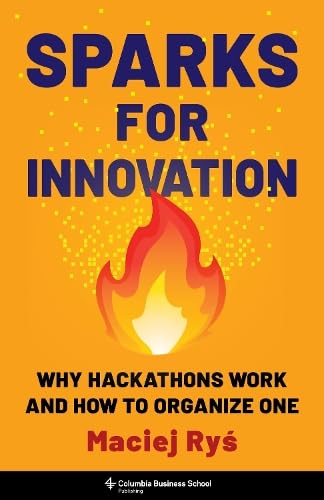
Sparks for innovation : why hackathons work and how to organize one / Maciej Ryś.
Publisher: New York : Columbia University Press, ©2025Description: 222 pagesContent type:- text
- unmediated
- volume
- 9780231214681
- T175.5 .R97 2025
 BOOKS
BOOKS
| Current library | Home library | Call number | Status | Barcode | |
|---|---|---|---|---|---|
| Alfaisal University On Shelf | Alfaisal University On Shelf | T175.5 .R97 2025 (Browse shelf(Opens below)) | Available | AU00000000020851 |
Browsing Alfaisal University shelves, Shelving location: On Shelf Close shelf browser (Hides shelf browser)

|

|

|

|

|

|

|
||
| T174.7 .P66 2003 Introduction to nanotechnology / | T174.7 .R64 2015 Nanotechnology : | T175 .M285 2016 Lean driven innovation : | T175.5 .R97 2025 Sparks for innovation : why hackathons work and how to organize one / | T183.G32 W45 2010 Die Essenz der Dinge : | T201 .S44 2019 One hundred patents that shaped the modern world / | T339 .M255 2015 Fundamentals of patenting and licensing for scientists and engineers / |
Includes bibliographical references and index.
Innovation, invention, and commercialization -- Innovation frameworks -- The rise of hackathons -- Hackathons' innovative black box -- Hackathons' shortcomings, their importance, and how to address them -- Summary and 10 steps to organize a (great) hackathon -- There is no rose without thorns.
"Innovation is one of the most meaningful resources for successful management at companies, be they disruptive start-ups or legacy companies aiming to pivot and progress as the business world evolves. With the increasing importance of tech in the business space, this book will examine hackathons as a means to facilitate innovation. How and why are they sources of invention? Do companies organize hackathons for said invention development, or do they have other motivations such as employer branding or general marketing? The author aims to answer these questions and others through interviews with professionals in the hackathon space and analysis of data on multiple hackathons, utilizing a novel method based on Grounded Theory and Machine Learning combined with the use of LDA for the data analysis. From a practitioner's perspective, this book will help companies build better hackathons and attract more participants. Readers will also gain a deeper understanding of knowledge and innovation management in the hackathon ecosystem. All told, this book will illustrate the effectiveness of hackathons in driving innovation across different business sectors while showing where the field has room to improve"--