


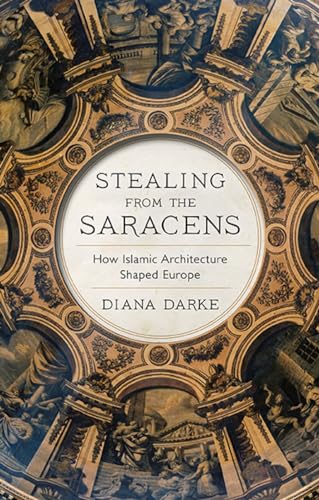
Stealing from the Saracens : how Islamic architecture shaped Europe / Diana Darke.
Publisher: London : Hurst & Company, 2024Description: viii, 474 pages : illustrations (chiefly color), color portrait ; 22 cmContent type:- text
- still image
- unmediated
- volume
- 9781911723479
- How Islamic architecture shaped Europe
- NA950 .D37 2024
 BOOKS
BOOKS
| Current library | Home library | Call number | Status | Barcode | |
|---|---|---|---|---|---|
| Alfaisal University On Shelf | Alfaisal University On Shelf | NA950 .D37 2024 (Browse shelf(Opens below)) | Available | AU00000000020965 |
Browsing Alfaisal University shelves, Shelving location: On Shelf Close shelf browser (Hides shelf browser)

|

|

|

|

|

|

|
||
| NA859.M46 A4 2015 Paulo Mendes da Rocha : | NA869.B76 A4 2016 Enrique Browne : | NA937.C37 G66 2017 CARACAS: ARCHITECTURAL GUIDE. | NA950 .D37 2024 Stealing from the Saracens : how Islamic architecture shaped Europe / | NA956 .B47 2000 European architecture 1750-1890 / | NA958 .B83 2019 Graphic assembly : | NA958 .E88 2012 European architecture in details / |
Includes bibliographical references (pages 443-449) and index.
Christopher Wren: the arch-synthesiser -- Gothic architecture: 'the Saracen style' -- The pre-Islamic inheritance: pagan and early Christian architecture in Syria -- The first Islamic empire: the Umayyads in Syria (661-750) -- Andalusia: the Umayyads in Spain (756-1492) -- The Abbasid and Fatimid caliphates (750-1258) -- Gateways to Europe (800-1400) -- The Seljuks, the Ottomans and Sinan (1075-1924) -- The revivals: Neo-Gothic, Neo-Saracenic, Neo-Moorish (1717-2026) -- Iconic buildings of Europe: a gallery of images with key influences.
Europeans are in denial. Against a backdrop of Islamophobia, they are increasingly distancing themselves from their cultural debt to the Muslim world. But while the legacy of Islam and the Middle East is in danger of being airbrushed out of Western history, its traces can still be detected in some of Europe's most recognisable monuments, from Notre-Dame to St Paul's Cathedral.0In this comprehensively illustrated book, Diana Darke sets out to redress the balance, revealing the Arab and Islamic roots of Europe's architectural heritage. She tracks the transmission of key innovations from the great capitals of Islam's early empires, Damascus and Baghdad, via Muslim Spain and Sicily into Europe. Medieval crusaders, pilgrims and merchants from Europe later encountered Arab Muslim culture in journeys to the Holy Land. In more recent centuries, that same route through modern-day Turkey connected Ottoman culture with the West, leading Sir Christopher Wren himself to believe that Gothic architecture should more rightly be called 'the Saracen style', because of its Islamic origins.0Recovering this overlooked story within the West's long history of borrowing from the Islamic world, Darke sheds new light on Europe's buildings and offers rich insights into the possibilities of cultural exchange --