


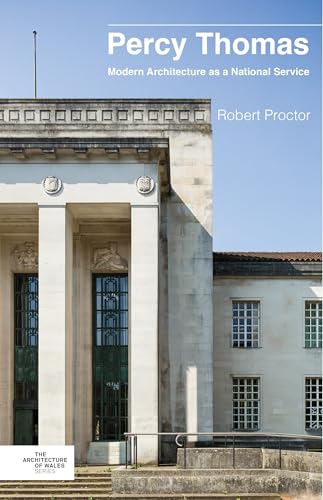
Percy Thomas : modern architecture as a national service / Robert Proctor.
Series: Architecture of WalesPublisher: Cardiff : University of Wales Press, 2025Description: xviii, 291 pages, 4 unnumbered pages of plates : illustrations (some color) ; 24 cmContent type:- text
- unmediated
- volume
- 1837722102
- 9781837722105
- NA997.T48 P76 2025
 BOOKS
BOOKS
| Current library | Home library | Call number | Status | Barcode | |
|---|---|---|---|---|---|
| Alfaisal University New Arrival | Alfaisal University New Arrival | NA997.T48 P76 2025 (Browse shelf(Opens below)) | Available | AU00000000020970 |
Browsing Alfaisal University shelves, Shelving location: New Arrival Close shelf browser (Hides shelf browser)

|

|

|

|

|

|

|
||
| KZ7360 .C45 2025 The evolution of international criminal procedure : | N6263.B67 M879 2015 Ink silk & gold : | NA200 .P35 2016 Historical dictionary of architecture / | NA997.T48 P76 2025 Percy Thomas : modern architecture as a national service / | NK2110 .H68 2015 Houses now : | PL248.S474 M3413 2015 The gaze / | PQ4866.E6345 S77513 2015 The story of the lost child / |
Includes bibliographical references and index.
"Sir Percy Thomas was the most important twentieth-century architect in Wales, renowned for interwar civic buildings such as Swansea Guildhall and the Temple of Peace in Cardiff. His architectural practice, Sir Percy Thomas & Son, designed much of the post-1945 welfare state and industry in Wales and beyond. In the late twentieth century, the Percy Thomas Partnership specialised in complex healthcare, industrial and public buildings, becoming an international practice. This comprehensive, meticulously-researched history examines the architecture of Percy Thomas in depth for the first time, and explores its wider social and political significance. Arguing that the practice sustained an ethical approach to architecture as a 'national service' for the benefit of society, this book gives new insights into the role of the architect and the changing relationships between the built environment and the state throughout the century. Its unique perspective from Wales promises to reshape our understanding of modern architecture."-- back cover.