


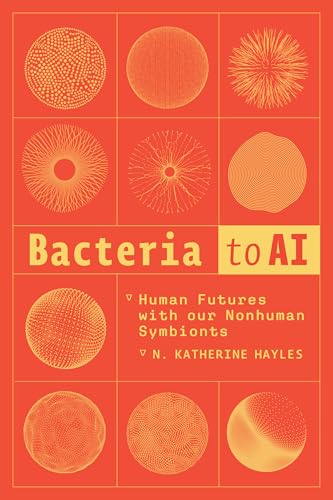
Bacteria to AI : human futures with our nonhuman symbionts / N. Katherine Hayles.
Publisher: Chicago ; London : The University of Chicago Press, 2025Description: 287 pagesContent type:- text
- unmediated
- volume
- 9780226837475
- BF311 .H3948 2025
 BOOKS
BOOKS
| Current library | Home library | Call number | Status | Barcode | |
|---|---|---|---|---|---|
| Alfaisal University On Shelf | Alfaisal University On Shelf | BF311 .H3948 2025 (Browse shelf(Opens below)) | Available | AU00000000021186 |
Browsing Alfaisal University shelves, Shelving location: On Shelf Close shelf browser (Hides shelf browser)

|

|

|

|

|

|

|
||
| BF311 .F53 2017 The five senses and beyond : | BF311 .G7135 2015 Mind change : | BF311 .H3527 2019 Conscious : | BF311 .H3948 2025 Bacteria to AI : human futures with our nonhuman symbionts / | BF311 .H614 2018 Cognitive assessment for clinicians / | BF311 .J36 2000 The origin of consciousness in the breakdown of the bicameral mind / | BF318 .C366 2014 How we learn : |
Includes bibliographical references and index.
An integrated cognitive framework -- Can computers create meanings? : a technosymbiotic perspective -- The emergence of technosymbiosis and Gaia theory -- Cellular cognition : mimetic bacteria and xenobot creativity -- Rocks and microbes : the two different temporal regimes of biological and mineral evolution -- Inside the mind of an AI : materiality and the crisis of representation -- GPT-4 : the leap from correlation to causality and its implications -- Subversion of the human aura ; three fictions of conscious robots -- Collective intelligences : assessing the roles of humans and AIs -- Planetary reversal : ecological relationality versus political liberalism.
"Humans are driving the planet toward catastrophe, and yet humans are the only species capable of taking positive actions on a global scale to prevent collapse. For N. Katherine Hayles, human hubris and the anthropocentrism that underlies it is one of the main drivers of our current planetary crises. So, if we are to take action to save the planet, we urgently need to re-think basic assumptions about agency, decision-making, control, and our relations to nonhuman and artificial cognizers. In Bacteria to AI, Hayles develops an integrated cognitive framework (ICF) that includes humans, nonhuman lifeforms, and some computational media, including artificial intelligence. Bacteria to AI analyzes how the first-order emergences of physical phenomena, multicellularity, and technics are now interacting together to create second-order emergences that greatly accelerate technical developments. The book explores these entanglements through case studies ranging from gene editing to autopoiesis and Gaia theory, bacteria and xenobots to artificial intelligence. Spanning evolutionary biology, artificial intelligence, and contemporary literature, Bacteria to AI recognizes the risks of contemporary technologies but insists a positive way forward, with ICF at its core, is possible for us and for the more than human world"--