

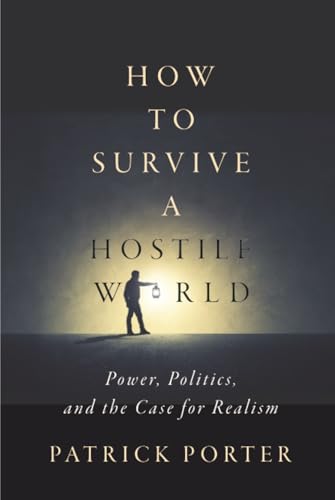
How to survive a hostile world : power, politics, and the case for realism / Patrick Porter.
Publisher: Stanford, California : Stanford University Press, © 2025Description: 192 pagesContent type:- text
- unmediated
- volume
- 9781503641839
- JZ1307 .P67 2025
 BOOKS
BOOKS
| Current library | Home library | Call number | Status | Barcode | |
|---|---|---|---|---|---|
| Alfaisal University On Shelf | Alfaisal University On Shelf | JZ1307 .P67 2025 (Browse shelf(Opens below)) | Available | AU00000000021305 |
Browsing Alfaisal University shelves, Shelving location: On Shelf Close shelf browser (Hides shelf browser)

|

|

|

|

|

|

|
||
| JZ1305 .V56 2023 International relations theory / | JZ1305 .W43 2020 International relations theory : | JZ1306 .R37 2023 Right and wronged in international relations : | JZ1307 .P67 2025 How to survive a hostile world : power, politics, and the case for realism / | JZ1307 .R56 2016 Neoclassical realist theory of international politics / | JZ1308 .B37 2023 International organization : | JZ1308 .B58 2018 Understanding international diplomacy : |
Includes bibliographical references and index.
Realism is moral -- Realism is realistic -- Realism is for everyone.
"The oldest ideas are the best. This book is a defense of an ancient way of thinking about international politics: realism. Patrick Porter, a scholar of international relations, defends the realist approach to understanding the world by addressing head-on the most robust critiques of the tradition. Drawing from a wide literature, Porter restages three prominent criticisms of realism: that it is immoral, unrealistic, and provincial. In erudite, clear, and at times morbidly funny prose, Porter makes the case that realism is, in fact, everything its critics believe it is not: moral in its commitment to securing the polity and its interests in a world where there is no higher government; realistic and the best starting point for explaining how human groups tend to behave; and practical for use by everyone, everywhere, including beyond the Euro-Atlantic. From Thucydides to Kautilya to Machiavelli, realists claim that the world is an inherently dangerous place defined by the shadow of conflict, whether we like it or not. As the 21st century grapples with multiple interlocking crises concerning economic dislocation, climate crisis, and war, we need realism now more than ever. This book is for readers who are looking for sensible guidance on how to work within that reality and survive in an increasingly hostile world"-- Provided by publisher.