


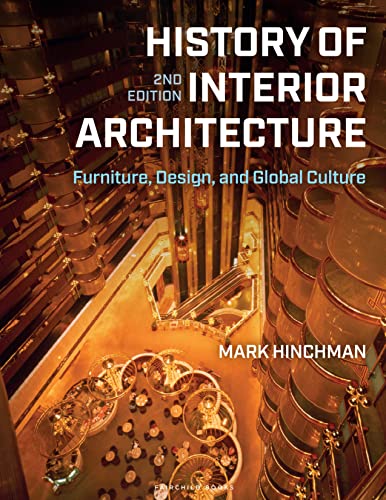
History of interior architecture : furniture, design, and global culture / Mark Hinchman, University of Nebraska, Lincoln.
Publisher: New York [New York] ; London [England] : Fairchild Books, 2024Copyright date: Ã2024Edition: Second editionDescription: xxi, 520 pages : illustrations (chiefly color), plans (chiefly black and white) ; 28 cmContent type:- text
- still image
- unmediated
- volume
- 9781501385605
- Furniture, design, and global culture
- NK2270 .H535 2024
 BOOKS
BOOKS
| Current library | Home library | Call number | Status | Barcode | |
|---|---|---|---|---|---|
| Alfaisal University On Shelf | Alfaisal University On Shelf | NK2270 .H535 2024 (Browse shelf(Opens below)) | Available | AU00000000021312 |
Browsing Alfaisal University shelves, Shelving location: On Shelf Close shelf browser (Hides shelf browser)

|

|

|

|

|

|

|
||
| NK2195.S89 M46 2019 Retail design / | NK2195.S89 W66 2016 Wonderwall case studies : | NK2260 .B66 2014 Furniture for interior design / | NK2270 .H535 2024 History of interior architecture : furniture, design, and global culture / | NK2270 .L39 2013 Furniture design : | NK2350 .R68 2012 Masters & their pieces : | NK2550.C48 A4 2016 Pierre Chareau : Modern Architecture and Design / |
Revised edition of: History of furniture : a global view / Mark Hinchman. New York : Fairchild Books, [2009] Ã2009.
"Glossary": pages 494-503.
Includes bibliographical references and index.
Preface: Chronology ; Objects of scrutiny ; Styles ; Meanings ; Conclusion -- Prehistory: Lascaux ; Neolithic ; Bronze Age ; Conclusion -- Ancient civilizations: Mesopotamia ; Egypt ; Nubia ; Conclusion -- Classical civilizations: Greece : Minoan and Mycenaean ; Classical Greece ; Rome ; Conclusion -- Early Christian and Byzantine: Early Christian ; Early Christian and Byzantine churches ; Conclusion -- Romanesque and Islamic: Romanesque ; Islam ; Conclusion -- Gothic: Civic infrastructure ; Interiors and furniture ; Conclusion -- The Americas: Early history ; Mexico ; Zapotecs ; Maya ; Aztecs ; Central America ; Peru ; Conquest ; Conclusion -- China, India, and Southeast Asia: Architecture and sculpture ; From stupa to pagoda ; Chinese classical furniture ; Conclusion -- Renaissance: Architecture ; Interiors ; Furniture ; Conclusion -- Baroque: Italy ; Central and Northern Europe ; France ; Conclusion -- Rococo: From Baroque to Rococo : regency ; Rococo ; Conclusion -- England: Tudor ; Elizabethan ; Jacobean ; Georgian ; Conclusion -- In the Colonies: English colonial ; India ; Spanish colonial ; French colonial ; German colonial ; Conclusion -- Neoclassicism: France ; United States ; England ; Germany ; Sweden ; Neoclassicism and Romanticism ; Conclusion -- Victorian and historical revivals: Queen Victoria ; Historic revivals ; The Industrial Revolution ; Furniture ; Conclusion -- Reform movements : arts and crafts: Arts and crafts ; Germany ; United States ; New Zealand ; Conclusion -- Africa: The classic African house ; Designed objects before industrialization ; Industrialization in Africa ; Furniture ; Conclusion -- Japan and Japonisme: Architecture ; Foreigners ; Urban and urbane living : furnishings in prints ; Furniture ; The opening of old Japan ; Conclusion -- Art nouveau: English beginnings ; Belgium ; France ; Spain ; United States ; Global ; Conclusion -- Protomodernism: Vienna secession ; De Stijl ; Russian constructivism ; Mackintosh ; Thailand ; Frank Lloyd Wright ; Conclusion -- Heroic Modernism : myths and realities: Early Modernism ; Franco Modernism ; Nordic Modernism ; British Modernism ; The lighter side of Modernism ; Conclusion -- Art deco, traditional continues, and decorators: Art deco ; Tradition : a continuity with the past ; The rise of the decorator ; Conclusion -- Other Modernisms: Latin America ; Africa ; Asia and the Pacific ; Conclusion -- Work : commercial interiors: The service economy ; Freestanding furniture ; The designers and office buildings ; The international turn ; The modern office ; Textiles ; Bèurolandshaft ; Conclusion -- After Modernism : Modernism continues, the 1960s and 1970s: Modernism continued ; Revolution : the 1960s ; Experimentation : the 1970s ; Conclusion -- Postmodernism: Theoretical framework ; Three competitions : Portland, New York, and Chicago ; New Urbanism ; Conclusion -- Deconstruction: Modernism continues ; Designers in the 1990s ; Conclusion.
"In today's globalized world, every aspect of our lives is affected by global interconnectedness from what we buy to what we eat to what we study--and the study of design history is no exception. Programs in art, architecture, and interior design are all facing the challenges of providing students with information from around the world. 'History of interior architecture: furniture, design, and global culture,' second edition, (formerly titled 'History of furniture: a global view') covers the major historical movements in architecture, interior design, furniture, and the decorative arts from prehistoric periods through contemporary times, and it includes parts of the world that traditional history books ignore or underserve such as Africa, Asia, and Latin America. It presents, moreover, the achievements of Western designers, not in isolation from the rest of the globe, but in vibrant contact with it. For example, students will learn about the influence of Islamic design on Romanesque style and Thailand's interpretation of Art nouveau. In short, this comprehensive book with a global perspective focuses on the evolution of interior design from ancient history through deconstruction with lens on societal issues, like politics, economics, gender, technology, ethics, and sociology, in addition to history and aesthetics. Features: highlights the contributions of women; considers interior architecture in conjunction with other disciplines, including urban design, landscape design, graphic design, and fashion. New to this edition: focus on the 20th and 21st centuries, while streamlining earlier historical chapters, in accordance with the current curriculum; discusses user-focused design, sustainability, and universal design; first edition to include online ancillary package with STUDIO features and instructor resources. STUDIO features includes: self-assessment quizzes to test yourself on what you have just read; 'Visual and vocabulary flashcards' of key terms and concepts covered in the book. Instructor resources: 'Instructor's guide' to help incorporate the text into your classroom; PowerPoint slides for every chapter."--