


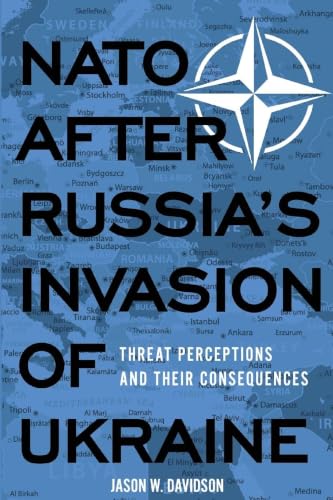
NATO after Russia's invasion of Ukraine : threat perceptions and their consequences / Jason W. Davidson.
Publisher: Washington, DC : Georgetown University Press, ©2026Description: 253 pagesContent type:- text
- unmediated
- volume
- 9781647126711
- JZ5930 .D38 2026
 BOOKS
BOOKS
| Current library | Home library | Call number | Status | Barcode | |
|---|---|---|---|---|---|
| Alfaisal University On Shelf | Alfaisal University On Shelf | JZ5930 .D38 2026 (Browse shelf(Opens below)) | Available | AU00000000021406 |
Browsing Alfaisal University shelves, Shelving location: On Shelf Close shelf browser (Hides shelf browser)

|

|

|

|

|

|

|
||
| JZ5665 .P36 2025 The new nuclear age : at the precipice of Armageddon / | JZ5675 .P384 2025 The art of coercion : credible threats and the assurance dilemma / | JZ5695 .O25 2020 Cybersecurity for Space | JZ5930 .D38 2026 NATO after Russia's invasion of Ukraine : threat perceptions and their consequences / | JZ5930 .E83 2023 Evaluating NATO enlargement from Cold War victory to the Russia-Ukraine war | JZ6005 .E43 2009 Virus alert : | JZ6009 .A78 G73 2022 The Indian Ocean as a new political and security region |
Includes bibliographical references and index.
Introduction -- Poland -- The United Kingdom -- France -- Italy -- Germany -- United States -- Conclusion.
"Since Russia's full-scale invasion of Ukraine in 2022, many observers have asserted that the North Atlantic Treaty Organization (NATO) has found new unity and purpose in opposition to Russian expansionism. Jason W. Davidson finds that these assertions are wrong. Through interviews in six key countries and an examination of policy documents and speeches, Davidson finds that NATO's leading member states still perceive different threats or view the same threat with differing levels of concern. This book specifically focuses on the following NATO members: the United States, Poland, Germany, Italy, France, and the United Kingdom. Davidson finds varying levels of concern over Russia's actions and preoccupation with other potential threats such as China or instability in the Mediterranean region. Understanding these differing threat perceptions is important because they are the driving factors explaining each ally's major defense decisions such as military spending, structure, and posture. This timely re-examination of NATO members' threat perceptions anticipates a rocky period ahead for NATO during the second Trump administration where questions of defense spending, commitment to collective security, and clashing priorities will test the bonds of the alliance"-- Provided by publisher.