


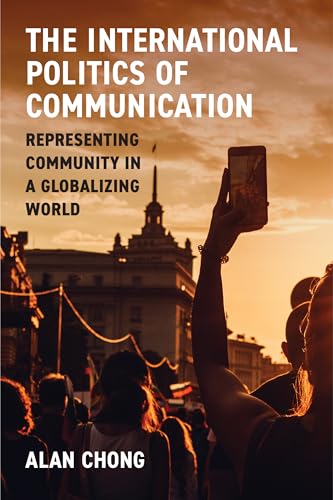
International politics of communication : representing community in a globalizing world / Alan Chong.
Publisher: Ann Arbor : University of Michigan Press, 2025Description: 440 pages cmContent type:- text
- unmediated
- volume
- 9780472057313
- P96.I5 C46 2025
 BOOKS
BOOKS
| Current library | Home library | Call number | Status | Barcode | |
|---|---|---|---|---|---|
| Alfaisal University On Shelf | Alfaisal University On Shelf | P96.I5 C46 2025 (Browse shelf(Opens below)) | Available | AU00000000021326 |
Browsing Alfaisal University shelves, Shelving location: On Shelf Close shelf browser (Hides shelf browser)
| No cover image available |

|

|

|

|

|

|
||
| P96.A83 W428 2016 The marketplace of attention | P96.A86 B835 2018 Storytelling for virtual reality : | P96.H43 W35 2016 Mass media and health : | P96.I5 C46 2025 International politics of communication : representing community in a globalizing world / | P96.I5 .V534 2008 The KOD system : | P96 .I84 O56 2018 On Islam : | P96.M34 C66 2023 Media management and artificial intelligence : |
Includes bibliographical references and index.
"In an era of globalization, international communication constantly takes place across borders, defying sovereign control as it influences opinion. While diplomacy between states is the visible face of international relations, this "informal diplomacy" is usually less visible but no less powerful. Information politics can be found in propaganda, Internet politics, educational exchanges, tourism, and even popular film. The International Politics of Communication examines this informational dimension of international politics, investigating how information is generated, conveyed through channels, and directed specifically at audiences. While citizens are often portrayed as faithfully loyal supporters and beneficiaries of the modern nation-state-a fiction supported by passports, identification papers, and other notarized credentials-they are subject to the pulls of loyalty from transnational tribal affiliations, mythological and historical narratives of ethnicity, as well as the transcendental claims of religion and philosophy. Increasingly, social media also enchants non-state individuals, providing new virtual communities as the center of loyalties rather than national affiliations. By reinterpreting taken-for-granted concepts in journalism, media, political economy, nationalism, development, and propaganda as information politics, this book prepares serious-minded scholars, citizens, politicians, and social activists everywhere to understand the power plays in international communication and use alternatives to begin transforming power relations."--