

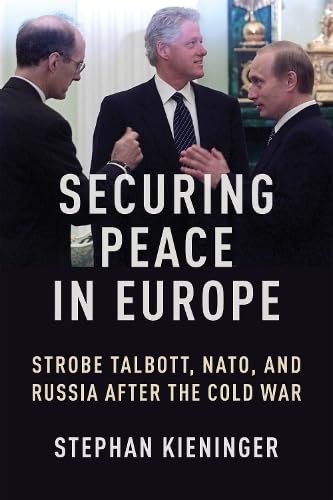
Securing peace in Europe : Strobe Talbott, NATO, and Russia after the Cold War / Stephan Kieninger.
Series: Woodrow Wilson Center seriesPublisher: New York : Columbia University Press, ©2025Description: 339 pages cmContent type:- text
- unmediated
- volume
- 9780231217712
- Strobe Talbott, NATO, and Russia after the Cold War
- Talbott, Strobe
- North Atlantic Treaty Organization
- Foreign ministers -- United States
- United States -- Foreign relations -- 1993-2001
- United States -- Foreign relations -- Europe
- Europe -- Foreign relations -- United States
- United States -- Foreign relations -- Russia (Federation)
- Russia (Federation) -- Foreign relations -- United States
- E885 .K54 2025
 BOOKS
BOOKS
| Current library | Home library | Call number | Status | Barcode | |
|---|---|---|---|---|---|
| Alfaisal University On Shelf | Alfaisal University On Shelf | E885 .K54 2025 (Browse shelf(Opens below)) | Available | AU00000000021401 |
Includes bibliographical references and index.
Foreword / Javier Solana -- Preface: Formative years and journalism introduction -- U.S. foreign policy and the European security mess -- Engaging Russia and enlarging NATO -- Building a new security architecture -- The NATO-Russia Founding Act and its aftermath -- Russia's financial crisis and the end of reform -- The Kosovo War as a game changer -- Putin and the crisis of U.S.-Russia relations.
"After the Cold War, the United States and its NATO allies faced crucial questions. Could Russia, their old adversary, be integrated into the liberal international order? What roles should former Soviet republics and satellite states in Eastern and Central Europe play in the Euro-Atlantic security system? These questions have taken on renewed significance since Russia's full-scale invasion of Ukraine, as Vladimir Putin has portrayed Russia as the victim of Western expansionism. This deeply researched book offers new perspective on the NATO-Russia relationship through the eyes of Strobe Talbott, a deputy secretary of state for seven years under President Bill Clinton and the key US diplomatic broker for the former USSR. Stephan Kieninger traces the Clinton administration's efforts to engage Russia and enlarge NATO at the same time, as elements of a new European security architecture. Drawing on Talbott's diaries, as well as US and European archives and extensive interviews with former government officials, he sheds light on NATO's opening, its missions in Bosnia and Kosovo, and other vexed issues. Kieninger argues that a careful look at Talbott's statecraft rebuts Putin's claims that the West exploited Russia's weakness after the Cold War, demonstrating that the Clinton administration and its NATO allies sought to include Russia at every step"-- Provided by publisher.