


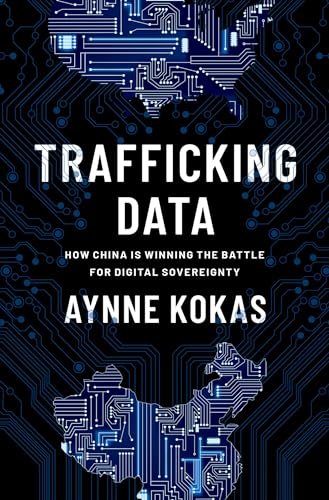
Trafficking data : how China is winning the battle for digital sovereignty / Aynne Kokas.
Publisher: New York, NY : Oxford University Press, ©2023Description: xx, 335 pages ; 24 cmContent type:- text
- unmediated
- volume
- 9780197620502
- HD30.3815 .K65 2023
 BOOKS
BOOKS
| Current library | Home library | Call number | Status | Barcode | |
|---|---|---|---|---|---|
| Alfaisal University On Shelf | Alfaisal University On Shelf | HD30.3815 .K65 2023 (Browse shelf(Opens below)) | Available | AU00000000019757 |
Includes bibliographical references and index.
"Trafficking Data argues that the movement of human data across borders for political and financial gain is disenfranchising consumers, eroding national autonomy, and destabilizing sovereignty. Focusing on the United States and China, it traces how US government leadership failures, Silicon Valley's disruption fetish, and Wall Street's addiction to growth have yielded an unprecedented opportunity for Chinese firms to gather data in the United States and quietly send it back to China, and by extension, the Chinese government. Such "data trafficking," as the book names this insidious phenomenon, is enabled by the competing governance models of the world's two largest economies: mass government data aggregation in China and impenetrable corporate data management policies in the United States. China is stepping up its data trafficking efforts through national regulations, soft power persuasion, and tech investment, extending the scope of state control over domestic and international data and tech infrastructure, and thereby expanding its global influence. The United States, by contrast, is retreating from participation in foreign alliances, international organizations, and the systemic regulation of the tech industry-practices with the potential to counter data trafficking. Confronting data trafficking as the defining international competition of the twenty-first century, this book ultimately advocates for an alternative future of data stabilization. To stem data trafficking and stabilize data flows, it shows, policymakers can synthesize tools from across the private sector, public sector, multi-national organizations, and consumers to protect users, secure national sovereignty, and establish valuable international standards"--