


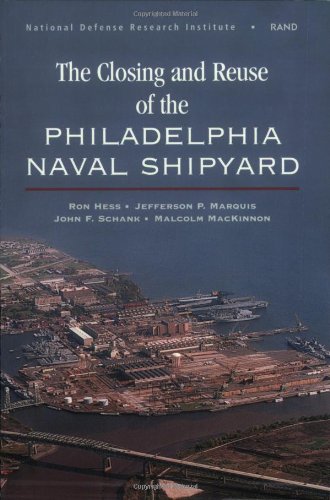
The closing and reuse of the Philadelphia Naval Shipyard / Ron Hess ... [et al.].
Publisher: Santa Monica, CA : RAND, 2001Description: xxviii, 114 pages : illustrations, maps ; 23 cmContent type:- text
- computer
- unmediated
- online resource
- volume
- 0833030434
- Kvaerner Philadelphia Shipyard
- Philadelphia Naval Shipyard (Philadelphia, Pa.) -- History
- Military base conversion -- Economic aspects -- Pennsylvania -- Philadelphia
- Navy-yards and naval stations -- Economic aspects -- Pennsylvania -- Philadelphia
- Shipbuilding industry -- Economic aspects -- Pennsylvania -- Philadelphia
- Shipbuilding -- Economic aspects -- Pennsylvania -- Philadelphia
- VM301.K93 C58 2001
- Also available on the internet via WWW in PDF format.
"National Defense Research Institute."
Includes bibliographical references (p. 105-114).
Introduction -- Base Closure Decisions -- Philadelphia's Reuse Plan -- The Navy's Closing Policies, Practices, and Costs -- First Attempt at a Private Shipyard: Meyer-Werft -- Kvaerner: A Deal Is Struck -- Aftermath of the 1997 Kvaerner Contract -- Observations -- Appendix A: Ships Built at the Philadelphia Naval Shipyard -- Appendix B: Philadelphia Naval Business Center Tenants.
The end of the Cold War had a significant impact on the economy of Philadelphia, Pa. After almost two centuries of operations, the naval shipyard there was forced to close, and the city was faced with the question: What would it do with the land, equipment, and buildings once the Navy had ceased to operate the yard? After giving a brief history of the nation's first government-owned shipyard (established in 1801), the authors detail the costs to the Navy and the Philadelphia region of closing the yard and the city's hunt for a commercial tenant. The report describes the distinctly European business philosophy of the eventual tenant, Norwegian shipbuilding giant Kvaerner, and the conditions of its deal with the city and concludes that the Philadelphia example should be considered by other U.S. military shipyards that might be faced with closure in the future.
Also available on the internet via WWW in PDF format.